-
The Chinese Legal System: Globalization and Local Legal Culture
Pitman B. Potter
The legal system of the People's Republic of China has seen significant changes since legal reforms began in 1978. At the end of the second decade of legal reform, law-making and institution-building have reached impressive levels. Understanding the operation and possible futures of law in the People's Republic of China requires an appreciation of the normative influences on the system, as well as an examination of how these norms have worked in practice.
[From The Chinese Legal System: Globalization and Local Legal Culture - 1st]
-
Academic Freedom and the Inclusive University
Sharon E. Kahn and Dennis Pavlich
Battles over human rights, curriculum issues and hiring and promotion practices reveal to what extent efforts to integrate ideas of academic freedom and the inclusive university have engendered strife and debate on Canadian campuses. For some, the concept of academic freedom has become its own myth – an icon to be revered, an article of faith, an essentialist doctrine with roots firmly planted in tradition. For others, the concept of an inclusive university – a university reflecting the burgeoning diversity of cultures and ideologies in Canadian society – demands realization through the transformation of university structures and practices.
The four parts of Academic Freedom and the Inclusive University explore this conflict. In Clarifying Concepts in Language, Law, and Ideology, contributors examine the terms of reference and clarify the differences between Canadian and American viewpoints. The Changing Culture looks at the conflict between academic freedom and the inclusive university from theoretical, historical, and personal perspectives. The chapters in Academic Freedom in Peril contend that inclusion as a policy within the university has destroyed the consensus necessary for academic life, while the essays in Theoretical and Practical Challenges to the Inclusive University focus on the problems that arise when universities promote a policy of inclusion.
Although no final conclusions are drawn in this thought-provoking book, it provides insight into the relationship between academic freedom and the inclusive university. Lively, impassioned and informed, these essays will appeal to general readers, academics, and students alike.
[From https://www.ubcpress.ca/academic-freedom-and-the-inclusive-university]
-
International Law Chiefly as Interpreted and Applied in Canada, 6th ed.
Hugh M. Kindred, Karin Mickelson, Ted L. McDorman, René Provost, Armand L.C. deMestral, Linda C. Reif, and Sharon A. Williams
-
Transforming Cultural Conflict in an Age of Complexity
Michelle Lebaron
Focuses on three distinct ways in which culture affects conflicts: culture as a lens that facilitates or blocks effective communication; culture and world view differences as the subject of conflicts; conflicts related to identity and recognition as facets of cultural differences. The author discusses challenges and concrete recommendations for process design in culturally-complex conflicts.
[From Transforming Cultural Conflict in an Age of Complexity - Berghof Foundation]
-
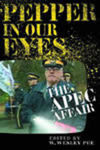
Pepper in Our Eyes: The APEC Affair
W. Wesley Pue
In November 1997, the world media converged on Vancouver to cover the Asia-Pacific Economic Cooperation summit. The major news story that emerged, however, had little to do with the crisis unfolding in the Asian economies. At the UBC campus, where the APEC leaders’ meeting was held, a predictable student protest met with an unusually strong police response. A crowd of students was pepper-sprayed, along with a CBC cameraman. The dramatic video footage of the incident that appeared on the evening news shocked Canadians. The use of noxious chemicals to attack non-violent protesters somehow seemed un-Canadian. It looked more like something that police and soldiers in less democratic countries would do.
Other news stories developed. Two dozen law professors wrote to Prime Minister Chrétien to report that a number of serious constitutional violations that had taken place on campus. One protester, held for fourteen hours for displaying a sign saying “Free Speech,” initiated legal proceedings. Other lawsuits followed. The RCMP and the government of Canada were named as defendants, and a public inquiry was launched. A central issue was whether the Prime Minister’s officials gave orders of a political nature to the police that resulted in law-abiding citizens being assaulted and arrested.
But why all the fuss? So what if the Prime Minister gave orders to the police? The contributors to Pepper in Our Eyes maintain that the “so what” question is of vital importance. The events at APEC raised serious questions about constitutional principle, the role of police in a democratic society, public accountability, and the effects of globalization on rights and politics. The contributors, experts in a variety of fields, draw upon their knowledge to explain – in plain English – the background issues and the values at stake. Some of the authors, such as Gerald Morin, chair of the first RCMP Public Complaints Commission, and CBC journalist Terry Milewski, had a direct connection with the APEC affair.
By getting at the fundamental issues behind the APEC affair, Pepper in Our Eyes seeks to raise our civic consciousness. It shows that there was much more at stake that day than the questionable use of pepper spray.
[From UBC Press | Pepper in Our Eyes - The APEC Affair, Edited by W. Wesley Pue]
-
The Law of Evidence: Fact Finding, Fairness and Advocacy
Christine Boyle, Marilyn MacCrimmon, and Dianne Martin
-
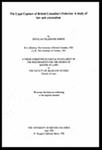
The Legal Capture of British Columbia's Fisheries: A Study of Law and Colonialism
Douglas C. Harris
Master of Laws - LLM Thesis
This is a study of the human conflict over fish in late nineteenth and early twentieth century British Columbia, and of how that conflict was shaped by law. Law, understood broadly to include both the legal forms of the Canadian state and those of Native peoples, defined and in part created both Native and state fisheries. When those fisheries clashed, one finds conflict between legal systems. When one fishery sought to replace the other, its laws had to replace the other. Thus, this is a study of law and colonialism, seen through a close analysis of the conflict over fish. Native fisheries and the web of regulation surrounding them preceded non-Native interest in British Columbia's fish. The fishery was not an open-access resource, but rather a commons, defined by entitlements, prohibitions and sanctions that allowed certain activity, proscribed others, permitted one group to catch fish at certain times in particular locations with particular technology, and prohibited others. The Canadian state denied the legitimacy and even the existence of Native fisheries law in imposing its law on the fishery. This study, based largely on government records and a secondary anthropological literature, describes the legal apparatus constructed by the Canadian state to reduce Native control of the fisheries in British Columbia through the creation, in law, of the "Indian food fishery". Law became a means of constructing a particular economic and social order that marginalized Native participation in the fishery and eliminated Native control. It was a "rhetoric of legitimation" that supported state domination, but also local resistance. Native peoples and their supporters used law, both Native and state law, to defend their fisheries. The history of the conflict over fish is the history of competing legal cultures, and the struggle on the Cowichan River and the Babine River over fish weirs reveals those cultures, constructed in opposition to each other. The study concludes by integrating the local conflicts over fish into a wider literature on law and colonialism, reflecting on the role of law in particular colonial settings.
-
Private International Law in Common Law Canada: Cases, Text and Materials
Marvin Baer, Joost Blom, Elizabeth Edinger, Nicholas Rafferty, Geneviève Saumier, and Catherine Walsh
-

Just Words: Constitutional Rights And Social Wrongs
Joel Bakan
The Canadian Charter of Rights is composed of words that describe the foundations of a just society: equality, freedom, and democracy. These words of justice have inspired struggles for civil rights, self-determination, trade unionism, the right to vote, and social welfare. Why is it, then, that fifteen years after the entrenchment of the Charter, social injustice remains pervasive in Canada?
Joel Bakan explains why the Charter has failed to promote social justice, and why it may even impede it. He argues that the Charter's fine-sounding words of justice are ‘just words.’ Freedom, equality and democracy are fundamental principles of social justice. The Canadian Charter of Rights and Freedoms entrenches them in Canada's highest law, the constitution. Yet the Charter has failed to promote social justice in Canada. In Just Words, Joel Bakan explains why.
Sophisticated in its analyses but clearly written and accessible, Just Words is cutting-edge commentary by one of Canada's rising intellectuals.
Joel Bakan argues that the Canadian Charter of Rights (1982) has failed to promote social justice because it is administered by a conservative judiciary and because social and economic conditions constantly interfere with its principles.
-
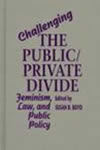
Challenging the Public/Private Divide: Feminism, Law, and Public Policy
Susan B. Boyd
Western thought has long been characterized by an ideological divide between public and private spheres. In the industrial era, the divide became highly gendered as men dominated the public spheres of politics and work, while women were closely associated with family and home. In the late twentieth century, social and legal policies have promoted equal opportunities in the labour force and shared responsibilities in the family. Despite this progress, inequalities are still evident for women in the labour force and in the family, and for some groups of women in relation to others.
In this collection of original essays, feminist scholars in disciplines ranging from law to geography challenge the traditional notion of a public/private divide. The divide can represent boundaries between state and family, state and market, market and family, or state and community, which shift depending on location, social group, and historical time period. The contributors to this book examine the impact of the divide in respect to four themes: state intervention; the relationship between family, home, and work; the legal regulation of motherhood; and the challenges of privatization, restructuring, and globalization. They show that the impact of the divide varies according to factors such as race, class, (dis)ability, and sexual identity as they intersect with gender.
Challenging the Public/Private Divide provides a wealth of information and analysis on current issues in Canada society, from child care to violence against women. Its impact will be felt in diverse disciplines, such as: law, public administration, political science, sociology, women's studies, and criminology.
Feminist scholars in disciplines ranging from law to geography challenge our traditional notion of a public/private divide in legal and public policy in Canada and internationally
[From Challenging the Public/Private Divide - University of Toronto Press]
-
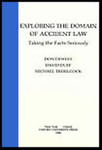
Exploring the Domain of Accident Law: Taking the Facts Seriously
Don Dewees, David G. Duff, and Michael Trebilcock
In the mid 1980s, there was a crisis in the availability, affordability, and adequacy of liability insurance in the United States and Canada. Mass tort claims such as the asbestos, DES, and Agent Orange litigation generated widespread public attention, and the tort system came to assume a heightened prominence in American life. While some scholars debate whether or not any such crisis still exists, there has been an increasing political, judicial and academic questioning of the goals and future of the tort system. Exploring the Domain of Tort Law reviews the evidence on the efficacy of the tort system and its alternatives. By looking at empirical evidence in five major categories of accidents--automobile, medical malpractice, product-related accidents, environmental injuries, and workplace injuries--the authors evaluate the degree to which the tort system conforms to three normative goals: deterrence, corrective justice, and distributive justice. In each case, the authors review the deterrence and compensatory properties of the tort system, and then review parallel bodies of evidence on regulatory, penal, and compensatory alternatives. Most of the academic literature on the tort system has traditionally been doctrinal or, in recent years, highly theoretical. Very little of this literature provides an in-depth consideration of how the system works, and whether or not there are any feasible alternatives. Exploring the Domain of Tort Law contributes valuable new evidence to the tort law reform debate. It will be of interest to academic lawyers and economists, policy analysts, policy professionals in government and research organizations, and all those affected by tort law reform.
[From Exploring The Domain Of Accident Law: Taking the Facts Seriously | Oxford Academic]
-
Social Justice and the Constitution: Perspectives on a Social Union for Canada
Joel Bakan and David Schneiderman
Printing is not supported at the primary Gallery Thumbnail page. Please first navigate to a specific Image before printing.