-

Protection of First Nations Cultural Heritage: Laws, Policy, and Reform
Robert K. Paterson
Indigenous peoples around the world are seeking greater control over tangible and intangible cultural heritage. In Canada, issues concerning repatriation and trade of material culture, heritage site protection, treatment of ancestral remains, and control over intangible heritage are governed by a complex legal and policy environment.
This companion volume to First Nations Cultural Heritage and Law looks at the key features of Canadian, US, and international law influencing indigenous cultural heritage in Canada. Legal and extralegal avenues for reform are examined, including ethics codes, research protocols, institutional policies, human rights law, and First Nation legal orders. The book also discusses the opportunities and limits of existing frameworks and questions whether a radical shift in legal and political relations is necessary for First Nations concerns to be meaningfully addressed.
-

The Hypothesis of Selective Adaptation and the Practice of Rule by Law in China
Pitman B. Potter and Gu Xiaorong
-
Climate Law and Developing Countries: Legal and Policy Challenges for the World Economy
Benjamin J Richardson, Yves Le Bouthillier, Heathe McLeod-Kilmurray, and Stepan Wood
This timely book examines the legal and policy challenges in international, regional and national settings, faced by developing countries in mitigating and adapting to climate change.
-

A Globally Integrated Climate Policy for Canada
Steven Bernstein, Jutta Brunnée, David G. Duff, and Andrew Green
A Globally Integrated Climate Policy for Canada builds on the premise that Canada is in need of an approach that effectively integrates domestic priorities and global policy imperatives.
-

Making People Illegal: What Globalization Means for Migration and Law
Catherine Dauvergne
This book examines the relationship between illegal migration and globalization. Under the pressures of globalizing forces, migration law is transformed into the last bastion of sovereignty. This explains the worldwide crackdown on extra-legal migration and informs the shape this crackdown is taking. It also means that migration law reflects key facets of globalization and addresses the central debates of globalization theory. This book looks at various migration law settings, asserting that differing but related globalization effects are discernable at each location. The “core samples” interrogated in the book are drawn from refugee law, illegal labor migration, human trafficking, security issues in migration law, and citizenship law. Special attention is paid to the roles played by the European Union and the United States in setting the terms of global engagement. The book’s conclusion considers what the rule of law contributes to transformed migration law.
-
Democratizing Pension Funds: Corporate Governance and Accountability
Ronald B. Davis
Pension funds own significant shares of the world’s largest corporations. However, the beneficiaries of pensions often have little or no say in corporate governance issues – in spite of their status as owners and even though the environmental, social, and economic performance of these corporations will impact not only their retirement accounts but also the very world into which they will retire.
Democratizing Pension Funds analyzes the reasons for this passivity, pointing to conflicts of interest with respect to corporate governance activity in pension plans and also to limitations in corporate, securities, and pension law. The author moves the debate further by arguing that these conflicts of interest can be addressed by giving plan members a voice in pension plan governance as well as making the pension plan accountable to them. He also outlines the legal reforms necessary to implement accountability.
This book will spark a debate concerning the need for democracy and accountability in the governance of trillions of dollars of plan members' pension plan assets and the legitimacy of the present, mostly unaccountable, corporate governance decisions made by these plans.
-
Women's Inequality in Canada: Submission of the Canadian Feminist Alliance for International Action to the United Nations Committee on the Elimination of Discrimination Against Women on the Occasion of the Committee's Review of Canada's 6th and 7th Reports
Shelagh Day, Margot Young, and Aileen Smith
-
The Social Contract Revisited: Tax Fairness and the Tax Mix
David G. Duff
This brief considers the concept of tax justice or fairness in relation to each of these broad goals: the collection of revenues to finance public expenditures, the regulation of social and economic behaviour, and the distribution of economic resources. With respect to the collection of revenue for public expenditures, it argues that traditional principles of taxation according to benefits received and ability to pay provide useful criteria to assess the justice or fairness of taxes for this purpose. Regarding the regulation of social and economic behaviour, principles of tax fairness necessarily assume a different character, related to the justice of the regulatory goal, the presence of a rational relationship between the tax or tax incentive and the regulatory goal, and the distributional effects produced by the tax or incentive. Finally, it contends, where a tax is designed to affect the distribution of economic resources, principles of tax fairness dissolve into broader considerations of distributive justice which determine the manner in which economic resources are fairly distributed and the respective roles of taxes and transfer payments to achieve this distributive goal. Together, the brief concludes, these principles support a mix of taxes, including benefit taxes and user fees, a broad-based consumption tax like a value-added tax, excise taxes on specific goods and services, as well as progressive income and wealth transfer taxes.
[From Tax fairness and the tax mix - ORA - Oxford University Research Archive]
-
The 2009 Annotated Bankruptcy and Insolvency Act
Lloyd W. Houlden, Geoffrey B. Morawetz, and Janis P. Sarra
-

Economic Rehabilitation: Understanding the Growth in Consumer Proposals
Janis P. Sarra
An Exploration of Fairness examines a concept that is simultaneously simple and extraordinarily complex: fairness. Simple in that we often intuitively understand situations to be fair or unfair. Complex, in that the notion of fairness is very much grounded in where we are situated, including race, gender, class, economic status, country, and life experience. There is considerable scholarship on the concept of fairness, but this volume is unique in the broad range of research disciplines that have come together to examine in depth what is meant by fairness, how it can be achieved, measured, and shared.
From its application in law, economics, and business to how it can be interpreted in cognitive neuroscience, developmental psychology, and kinesiology, it integrates the visual and performing arts as essential features of fairness. Through this interdisciplinary lens, the ethical and normative dimensions of fairness are understood, drawing on its historical and philosophical origins and its role in citizenship and political obligation. Each discipline, each chapter, informs the others to deepen our understanding of fairness.
-
Inaction and Non-Compliance: British Columbia's Approach to Women's Inequality: Submission of the BC CEDAW Group to the United Nations Committee on the Elimination of Discrimination Against Women on the Occasion of the Committee's Review of Canada's 6th and 7th Reports
Aileen Smith, Margot Young, and Shelagh Day
-
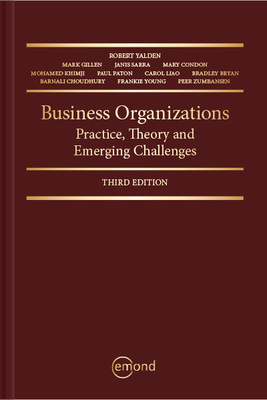
Business Organizations: Principles, Policies, and Practice - Robert Yalden, Janis Sarra, Paul D. Paton, Mark Gillen, Ronald Davis, & Mary Condon
Robert Yalden, Janis P. Sarra, Paul D. Paton, Mark Gillen, Ronald B. Davis, and Mary Condon
-

A Property Law Reader: Cases, Questions and Commentary, 2nd ed.
Bruce Ziff, Jeremy de Beer, Douglas C. Harris, and Margaret E. McCallum
-

Reaction and Resistance: Feminism, Law, and Social Change
Dorothy E. Chunn, Susan B. Boyd, and Hester Hester Lessard
The image of “backlash” is pervasive in contemporary debates about the impact of second-wave feminism on law and policy. But does it really explain the resistance to feminist initiatives for social change in contemporary culture?
In this timely volume, contributors from various disciplines analyze reaction and resistance to feminism in several areas of law and policy – child custody, child poverty, sexual harassment, and sexual assault – and in a number of institutional sites, such as courts, legislatures, families, the mainstream media, and the academy. Collectively, their studies paint a more complicated, often contradictory, picture of feminism, law, and social change than the popular image of backlash suggests.
Reaction and Resistance offers feminists and other activists empirically grounded knowledge that can be used to develop legal and political strategies for change.
Printing is not supported at the primary Gallery Thumbnail page. Please first navigate to a specific Image before printing.