-
The Constitution of the Environmental Emergency
Jocelyn Stacey
This book argues for a reframing of environmental law. It starts from the premise that all environmental issues confront lawmakers as emergencies. Environmental issues pose a fundamental challenge to law because it is impossible to reliably predict which issues contain the possibility of an emergency and what to do in response to such an unforeseen event. These features undermine the conventional understanding of the rule of law. This book argues that approaching environmental issues from the emergency perspective leads us to an understanding of the rule of law that requires public justification. This requirement recentres the debates in environmental law around the question of why governance under the rule of law is something worth having in the environmental context. It elaborates what the rule of law requires of decision-makers in light of our ever-present vulnerability to catastrophic environmental harm. Controversial, compelling and above all timely, this book presents an important new perspective on environmental law.
[From The Constitution of the Environmental Emergency: : Jocelyn Stacey: Hart Publishing]
-

Memory
Philippe Tortell, Mark Turin, and Margot Young
November 11, 2018, is the 100th anniversary of the end of the First World War, a time of remembering and memorial, of linking past events to the world we live in today. Taking this particular moment as a catalyst, this book examines the character and relevance of memory more broadly. The essays in this collection ask readers to think creatively and deeply about notions of memory – its composition and practices – and the ways that memory is transmitted, recorded, and distorted through time and space.
Memory navigates a broad terrain, with essays drawn from a diverse group of contributors who capture different perspectives on the idea of memory in fields ranging from molecular genetics, astrophysics and engineering, to law, Indigenous oral histories, and the natural world. This book challenges readers to think critically about memory, offering an engaging and interdisciplinary roadmap for exploring how, why, and when we remember.
Accessibly written, these lively essays will appeal to intellectually curious members of the public.
[From UBC Press | Memory, Edited by Philippe Tortell, Mark Turin and Margot Young]
-
Local Engagement With International Economic Law and Human Rights
Ljiljana Biuković and Pitman B. Potter
Providing an analysis of global regulation and the impact of international organizations on domestic laws, this collection grew out of a central objective to explore methods of domestic engagement with international trade and human rights norms, and the inherent difficulties in establishing balanced links between these two international law regimes. The common thread of the papers in this collection is a focus on the application of socio-legal normative paradigms in building knowledge and policy support for coordinating local performance with international trade and human rights standards in ways that are mutually sustaining.
[From Local Engagement with International Economic Law and Human Rights]
-
To Ensure that Justice is Done: Essays in Memory of Marc Rosenberg
Emma Cunliffe
To Ensure that Justice is Done: Essays in Memory of Marc Rosenberg brings together leading scholars, practitioners, and jurists who have written chapters in tribute to the Honourable Marc Rosenberg’s legal and ethical contributions to the administration of justice.
Inspired by his work as a teacher, a lawyer, and a judge, the contributors reflect on key trends and contemporary issues in jurisprudence, legal education, the administration of justice, and legal ethics. The contributors examine topics including wrongful convictions, social justice and the criminal law, the role of the judge and lawyer, challenges facing the law of evidence, the past and future of Charter justice, and the function of legal education in contributing to the administration of justice in Canada and abroad.
The book is, thus, both a tribute to the life, work, and contributions of Marc Rosenberg, and an indispensable resource for all those concerned with the ways in which we seek justice in and through the law.
[From To Ensure that Justice is Done: Essays in Memory of Marc Rosenberg | Thomson Reuters]
-
Innovation and the State: Finance, Regulation, and Justice
Cristie Ford
From social media to mortgage-backed securities, innovation carries both risk and opportunity. Groups of people win, and lose, when innovation changes the ground rules. Looking beyond formal politics, this new book by Cristie Ford argues that we need to recognize innovation, and financial innovation in particular, as a central challenge for regulation. Regulation is at the leading edge of politics and policy in ways that we have not yet fully grasped. Seemingly innocuous regulatory design choices have clear and profound practical ramifications for many of our most cherished social commitments. Innovation is a complex phenomenon that needs to be understood not only in technical terms, but also in human ones. Using financial regulation as her primary example, Ford argues for a fresh approach to regulation, which recognizes innovation for the regulatory challenge that it is, and which binds our cherished social values and our regulatory tools ever more tightly together.
[]from Innovation and the State]
-
The 2017 Annotated Bankruptcy and Insolvency Act
Lloyd W. Houlden, Geoffrey B. Morawetz, and Janis P. Sarra
-
How Ontario Could Lead the World in Sovereign Debt Restructuring
Mark Jewett and Maziar Peihani
In recent decades, sovereign debt crises — especially in Greece and Argentina — have spurred both controversy and interest. The world of sovereign debt is deeply dysfunctional. A true sovereign bankruptcy regime remains politically infeasible, and the prospects for establishing a comprehensive treaty on sovereign debt are bleak. Meanwhile, the contractual reforms intended to address the holdout problems, while welcome, have had only limited success. Between these two approaches is a third way: a model law on sovereign debt restructuring adopted by a legislature, as described in this policy brief.
The model law is the only reform initiative that offers the predictability and effectiveness of a statutory approach without foundering on the obstacles that frustrated previous reforms. As this policy brief argues, the model law provides a unique leadership opportunity for Ontario, enabling the province to establish an orderly sovereign debt resolution regime under the rule of law. The model law is unlikely to increase borrowing costs or adversely affect the province’s public finances. By its adoption, significant benefits would accrue to debtor states and creditors, and Ontario could further develop its capacities as a world-class financial jurisdiction. Both Ontario and the deeply dysfunctional sovereign debt world would benefit.
-
Canadian Constitutional Law, 5th ed.
Patrick Macklem, Carol Rogerson, John Borrows, Robin Elliot, Jean-François Gaudreault-DesBiens, Donn Greschner, Jean Leclair, Ian B. Lee, Richard Moon, R.C.B. Risk, Kent Roach, Bruce B. Ryder, David Schneiderman, Lorraine E. Weinrib, Richard Albert, Hamish Stewart, and Constitutional Law Group
-
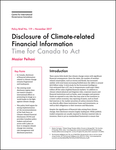
Disclosure of Climate-Related Financial Information: Time for Canada to Act
Maziar Peihani
In Canada, disclosure of financial information related to climate change remains fragmented and inadequate. The existing weak disclosure regime does not match Canada’s international efforts in promoting its image as a world leader in the fight against climate change. This policy brief argues for strong implementation of the recommendations of the Task Force on Climate-related Financial Disclosures and provides Canadian policy makers and private actors with a plan on how to integrate climate change into existing risk management and disclosure practices.
-

Victim Law: The Law of Victims of Crime in Canada
Benjamin Perrin
How victims of crime are treated by the justice system has emerged as a major societal issue, spurring legislative reforms, public inquiries, complaints against judges, and public debate. Victim Law: The Law of Victims of Crime in Canada is an invaluable peer-reviewed resource for judges, Crown prosecutors, defence counsel, police, victim service professionals, policy-makers, and scholars.
In this timely book, one of the architects of the new federal Victims Bill of Rights Act examines the growing body of legislation and case law related to victims of crime throughout the criminal justice, corrections, and youth criminal justice systems and under provincial and territorial laws. In addition to providing a comprehensive legal account of victim law, legislative and policy recommendations are made to enhance the responsiveness of the justice system to victims.
This resource separates itself into three parts; Federal Victim Law, Provincial Victim Law, and Territorial Victim Law. Each of these parts discuss in very specific detail the definition of "victim" and go on to related Acts that impact this area of law, including remedies for victims.
Victim Law was cited by the Supreme Court of Canada in R. v. Friesen, 2020 SCC 9, which is the leading case on sentencing for sexual offences against children. Professor Perrin’s legal scholarship has been cited with approval by other courts across Canada, including the Court of Appeal for British Columbia, the Ontario Court of Justice, the Superior Court of Justice – Ontario, the Provincial Court of Alberta, Supreme Court of Nova Scotia, Territorial Court of the Yukon and Nunavut Court of Justice.
[From Books]
-
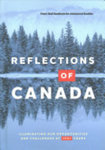
Reflections of Canada: Illuminating Our Opportunities and Challenges at 150+ Years
Philippe Tortell, Margot Young, and Peter Nemetz
Canada’s leading writers, researchers, and public intellectuals peer into the country’s future in the provocative essay collection published in the 150th year since Conferderation.
Reflections of Canada – intelligent, passionate, provocative – is a book with opinions as diverse as Canada. Leading thinkers take a stand on some of the most pressing issues facing Canada as it turns 150. Reflections of Canada inspires the reader to form her own opinions on subjects as big and thorny as health and aging, technological change, arts and culture, climate change and resource use, Aboriginal reconciliation, and multiculturalism
The contributions are as diverse as their subjects: George Elliott Clarke has submitted an original poem; renowned political scientist Max Cameron an essay on democratic reform; and UBC Museum of Anthropology director Anthony Shelton a strongly worded opinion piece about the inequitable funding of arts institutions in this country. The written pieces are accompanied by provocative photographs selected from a national photo competition. Each piece explores how our understanding of critical issues has changed over the past 150 years, and includes a call to action for how we should grapple with them over the coming decades
A book of lively, respectful debate, Reflections of Canada reaffirms the place for public discussion of major societal questions.
[From UBC Press | Reflections of Canada - Illuminating Our Opportunities and Challenges at 150+ Years]
-
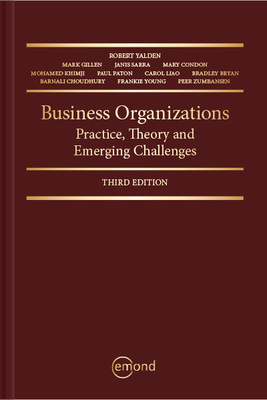
Business Organizations: Practice, Theory and Emerging Challenges, 2nd ed.
Robert Yalden, Janis P. Sarra, Paul Paton, Mark R. Gillen, Mary Condon, Carol Liao, Michael Deturbide, Mohamed Khimji, Bradley Bryan, and Gary Campo
Business Organizations: Practice, Theory and Emerging Challenges, 2nd Edition is more than just a comprehensive update to Business Organizations: Principles, Policies, and Practice. It provides a detailed discussion of the fundamentals that shape this area of law, and reviews important debates surrounding the nature of business organizations and the role they play in Canadian society. Through this approach, this casebook aims to enhance the reader’s understanding of business organizations, and the ways in which legal and policy decisions impact how they function.
In addition to substantial revisions and updates, this edition features entirely new material. Most notably, the text now includes chapters that engage emerging issues related to Indigenous peoples, which in part act as a response to the Calls to Action from the Final Report of the Truth and Reconciliation Commission of Canada. This edition also features a new chapter on social enterprises and the increased momentum of social entrepreneurship.
Drawing on the perspectives of leading Canadian business scholars and commentators, this text is designed to be an accessible classroom and research resource. It is a must-have addition to the faculty, firm, or private library of anyone interested in the various dimensions of the law of business organizations.
[From Business Organizations: Practice, Theory and Emerging Challenges, 2nd Edition | Emond Publishing]
-
The Ethics of Expert Evidence
Emma Cunliffe
The articles selected for this volume represent the best of the research conducted at the intersection of law, professional ethics and expert evidence. The collection incorporates legal perspectives from a wide range of jurisdictions, peer-reviewed literature drawn from expert disciplines, and critical law and society scholarship. It offers a corrective to the tendency to quarantine discussions of the ethics of expert testimony by jurisdiction, legal field, or area of expertise. The authors challenge preconceived notions of ethical performance, offer ideas for improvement, document failures to learn from and successes to emulate. The introduction identifies common themes and illuminating differences within the multidisciplinary scholarship on the ethics of expert testimony. It also delineates the multidimensional conceptions of ethics that drive this scholarship. Placing these essays side by side illustrates that the essential elements of ethical performance are now well understood. As ever, lively debates persist and are reflected within the essays selected. Nonetheless, this collection demonstrates that the major question that remains is whether legal systems and expert communities - institutions that sometimes resist change - can find the will to implement what has been learned from decades of careful, multi-disciplinary research.
[From The Ethics of Expert Evidence - 1st Edition - Emma Cunliffe - Routledg]
-
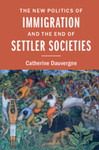
The New Politics of Immigration and the End of Settler Societies
Catherine Dauvergne
Over the past decade, a global convergence in migration policies has emerged, and with it a new, mean-spirited politics of immigration. It is now evident that the idea of a settler society, previously an important landmark in understanding migration, is a thing of the past. What are the consequences of this shift for how we imagine immigration? And for how we regulate it? This book analyzes the dramatic shift away from the settler society paradigm in light of the crisis of asylum, the fear of Islamic fundamentalism, and the demise of multiculturalism. What emerges is a radically original take on the new global politics of immigration that can explain policy paralysis in the face of rising death tolls, failing human rights arguments, and persistent state desires to treat migration as an economic calculus.
[From New politics immigration and end settler societies | Human rights | Cambridge University Press]
-
Basel Committee on Banking Supervision: An Assessment of Governance and Legitimacy - Part II
Maziar Peihani
Part I of this project overviewed the literature on the Basel Committee of Banking Supervision (BCBS) and provided a primer on the Committee’s governance and functions. It also engaged with the current theories on legitimacy and discussed what legitimacy meant for the global governance of banking and how it could be assessed. This part investigates the BCBS’s governance, operation, and policy outcomes to determine the extent to which it is and has been legitimate. The assessment is conducted based on three principles of reasoned decision making, transparency, and accountability. Maziar Peihani argues that the BCBS has gradually become a more legitimate institution but there still exists significant room for improvement. He highlights a number of areas for reform and sets out policy prescriptions to enhance the BCBS’s legitimacy.
[From Basel Committee on Banking Supervision – An Assessment of Governance and Legitimacy- Part II | Brill]
-
Basel Committee on Banking Supervision: A Primer on Governance, History, and Legitimacy - Part I
Maziar Peihani
The Basel Committee on Banking Supervision (BCBS) was established in 1974 as an informal group of central bankers and bank supervisors with the mandate to formulate supervisory standards and guidelines. Although the Committee does not have any formal supranational authority, it is the de facto global banking regulator and its recommendations have been widely implemented by member and non-member states. Maziar Peihani investigates the BCBS’s governance, operation, and policy outcomes to determine the extent to which it is and has been legitimate. The project is comprised of two parts. This part overviews the literature on the BCBS, outlines its contribution, and provides a primer on the Committee’s governance and functions. In addition, it engages with the current theories on legitimacy and discusses what legitimacy means for the global governance of banking and how it can be assessed.
Printing is not supported at the primary Gallery Thumbnail page. Please first navigate to a specific Image before printing.